
Business insuranceInsightsRisk Management
Food & Agriculture Resilience Requires Adapting Operations to Changing Market
Written by: Staff Writer | August 10, 2026
Jump to section
01
State of the Market
02
Insurance Trends
03
Major Risks for Food/Ag Businesses
04
Your Partner in Protection
State of the Market
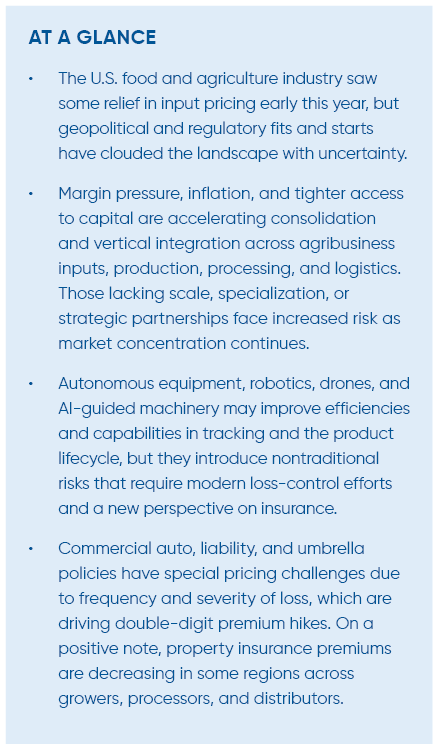
Food and agribusiness operators are facing a period of accelerated change. Weather, technology, labor, supply chains, heightened food safety expectations, and vertical integration and consolidation are reshaping risk across the entire agribusiness chain.
While each may generate risk outside a business’s control, owner hands are not tied. There are actions that can be taken to minimize risk of loss and capitalize on existing opportunities, including:
- Competent adoption of technology
- Cybersecurity enhancements
- Marketplace adaptations
- Safety program enforcement
- Robust integration of insurance products and services
Food/ag business owners who are willing to align their operations with today’s realities will be able to respond to challenges and sustain their business. That starts with asking the right questions about operations and risks. The perils may seem abstract until a self-assessment exercise is undertaken.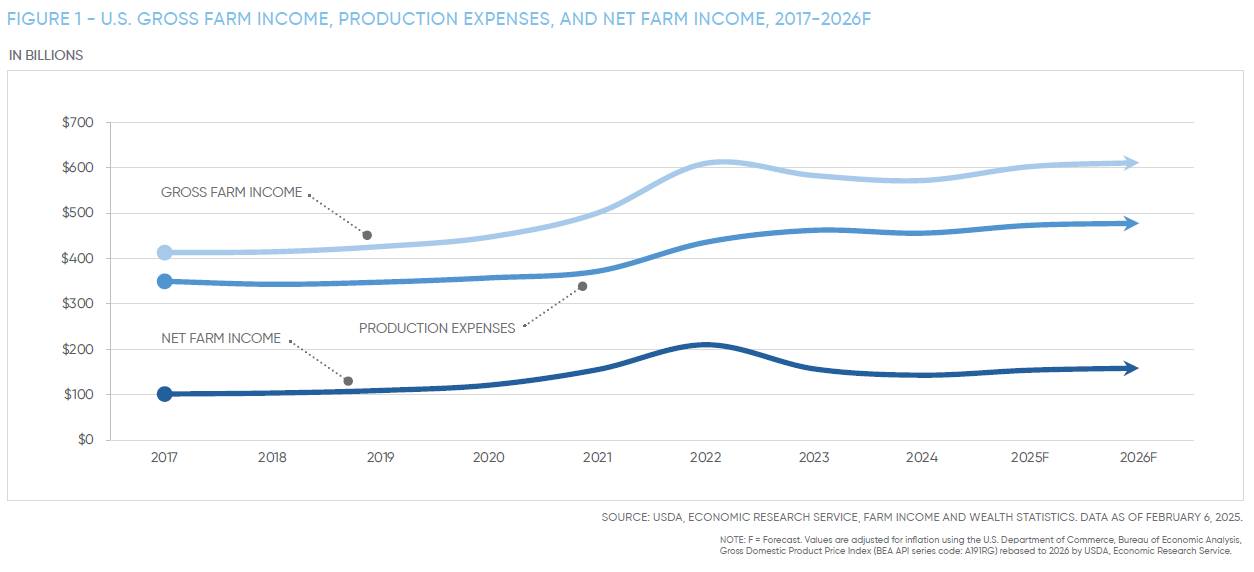
Insurance Trends
Commercial property insurance is one of the most favorably priced lines of coverage, with the largest overall decrease (5.5%) across coverage lines, according to the Council of Insurance Agents & Brokers (CIAB) Q1 2026 Commercial Property and Casualty Market Index. Even high-hazard manufacturing and food processing are experiencing double-digit reductions in premiums “where underwriting confidence is strong,” according to CRC Group’s 2026 Property State of the Market report.
Critical to favorable property insurance rates and terms are documentable risk-control efforts, especially fire suppression such as sprinklers, and a clean loss history. Food and agriculture businesses that can provide risk assessments, proof of safety programs, and accurate estimates of probable maximum loss make it easier for brokers to present a favorable image to underwriters and obtain better pricing and terms on policies.
Workers compensation receives many headlines for its decadelong premium relief, but it is highly dependent on each business’s actual claims performance. Those with poor safety histories or in higher-risk segments might not see the nationwide 3.7% average drop in rates reported by the CIAB. Notably, those using H-2A workers are facing increased complexity in their workers comp calculations for 2026. The U.S. Department of Labor’s new AEWR (adverse effect wage rates) methodology for wage floors includes skill-level pay differentiations, downward adjustments based on housing perquisites, and accommodations for state-based minimum wages. While workers comp rates might go down based on these new calculations, mistakes in classification or payroll computation could open companies up to audit difficulties and even penalties.
While claims numbers are hard to come by in liability cases due to the proprietary nature of insurance data, the industry largely agrees that risk is up in general liability, product liability, commercial auto liability, excess/umbrella, and product recall. Intel Market Research says in its Food Liability Insurance forecast for 2025-2032 that “average settlement values for foodborne illness claims have increased by over 40% in the past five years, with class-action lawsuits reaching multimillion-dollar settlements.” That finding and other reports indicate liability risks identified in IOA’s 2025 Food & Agriculture Market Outlook are persisting.
Major Risks for Food/Ag Businesses
Economic and regulatory pressures are transforming the food/ag marketplace and its risks. Everything from what is farmed to how it’s grown, harvested, processed, and distributed is changing rapidly. Federal and state laws are in a near constant state of flux, and technology is presenting both massive opportunities and salient financial challenges. Adding to the risk matrix are consumer expectations and the speed of information, which are increasing earnings potential as well as loss hazards.
A combination of risk transfer and loss control is the primary way to protect your organization’s sustainability. Here we offer some key risk considerations and questions to help you assess risk within your own organization.
 Alternative Proteins and Product Reformulation
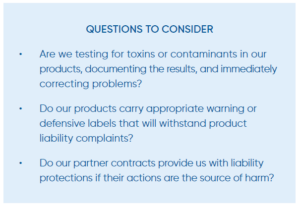
The food and agribusiness market is demanding cost-effective alternatives to traditional food, such as plant-based proteins optimized for price and functionality, hybrid proteins (plant and animal), and ingredient reformulation that helps manage supply shortages in foods such as eggs, dairy fats, and cocoa. Changes driven by availability, cost pressure, or sustainability goals can unintentionally introduce new liability risks.
These may include allergen exposure from ingredient substitution, labeling errors or reformulation discrepancies, and contaminants introduced through soil or processing. As a result, there is an increased likelihood of consumer complaints and recalls.
It is important to proactively align product liability and recall coverage with formulation changes and work to avoid coverage gaps related to emerging ingredients or processes.
 Labor Shortages and Autonomous Equipment
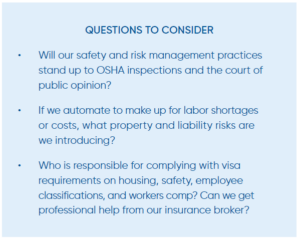
Food industry and agricultural employers need a reliable, consistent, and legal workforce to ensure a profitable operation. In 2025, nearly 400,000 agricultural worker positions were certified as eligible for the H-2A worker program, which has grown more than 185% in the last 10 years. And the H-2B program, which authorizes immigrant visas for food processing, almost doubled its allowance for visa approvals for FY 2026, according to the Department of Labor.
Despite the growth in worker importation, labor concerns are driving adoption of autonomous equipment, robotics, drones, and AI-guided machinery across planting, harvesting, and processing facilities. Fortune Business Insights estimates the market for such equipment has almost doubled in value since 2021 and will expand at a 16.6% compound annual growth rate through 2034. Equipped with GPS, AI, and sensors, these machines can learn over time and perform agricultural tasks with precision, Fortune Business says, reducing dependence on labor while improving production.
Both the human capital and autonomous equipment involved in the food/ag sector are potential sources of great productivity but abrupt financial risk. Key challenges include equipment-related losses, including damage to the machinery and income interruption related to equipment breakdown or damage; cyberattack-related damage to crops; high-severity workers compensation claims due to amputations and other permanently disabling injuries; field or floor worker illness from allergens, pathogens, or other infectious disease; supervisory liability; and regulatory compliance with worker safety, housing, and compensation rules.
 Regenerative and Climate-Smart Agriculture
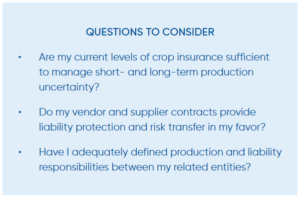
Regenerative practices such as cover cropping, reduced till, rotational grazing, and soil carbon measurement have moved from pilot programs to core sourcing strategies for major buyers like Walmart, PepsiCo, and Cargill. To meet buyer expectations and improve long-term soil health, many growers experience short-term operational uncertainty. Changes in inputs, yields, and contractual obligations can create unexpected financial stress and risk.
Key risk considerations include yield volatility during transition periods, failure to meet production or sustainability targets, and contractual penalties tied to performance or environmental commitments.
 Consolidation, Vertical Integration, and Expansion
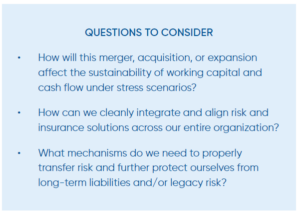
With the economic challenges the food and agricultural industry faces, consolidation and vertical integration are increasingly common. Such moves often help by diversifying sources of revenue and risk and by achieving greater scale and efficiencies. Mergers, acquisitions, and expansion of business scope—as profitable as they may be—introduce risks that may not have been considered as part of the M&A or expansion process.
Key risk considerations can include inherited claims history and potential coverage gaps, inconsistent insurance structures across new entities or locations, contractual obligations that are misunderstood after the M&A transaction, and/or sustainability and regulatory pressure.
 Traceability, Transparency, and Recall Readiness
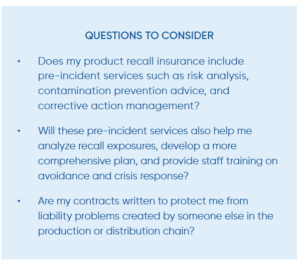
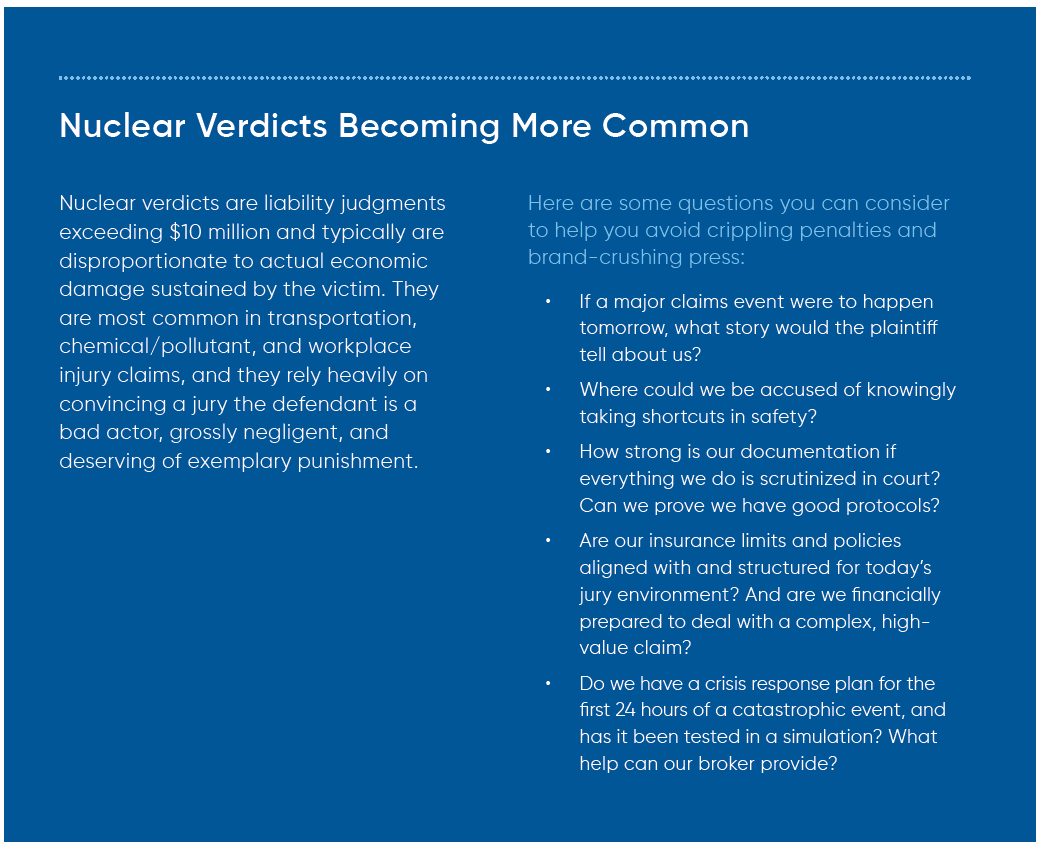
End-to-end traceability is becoming essential for market access, recall readiness, and insurance defensibility. Traceability systems increase accountability but also expand exposure to financial loss if errors occur. Regulatory scrutiny and buyer expectations have elevated the complexity, visibility, and cost of product recalls. Food may be safe, but if systems or food traceability data cannot prove it, you could face significant costs of investigation, legal defense, and removal of the affected product from the distribution chain. If illness or injury are alleged or proven, your liability costs could go “nuclear”—exceeding $10 million.
Not only do traceability problems escalate product recall and product liability expenses; they also could cause operational shutdowns, brand damage, and loss of buyer markets. Ensuring traceability throughout the food and beverage production chain can relieve some of the stress and cost of product defect claims.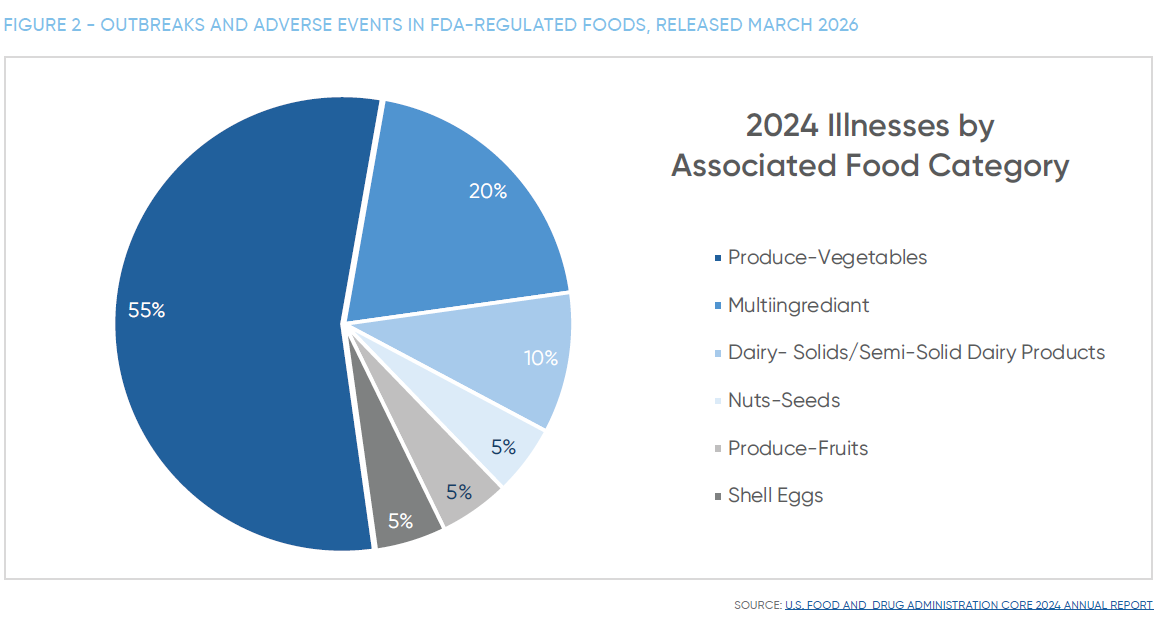
 Food Safety, Biosecurity, and Reputation Risk
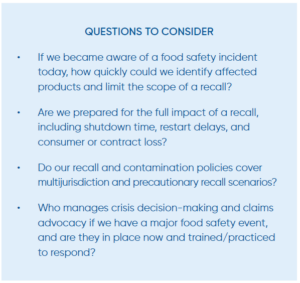
Food safety failures remain among the highest severity risks in the food and agribusiness sector. The number of foodborne contamination events continues to increase, which may be the result of improved pathogen diagnosis; longer supply chains; consumer preferences for raw, minimally processed, and unpasteurized products; lack of hygiene at growers and processors; poor equipment maintenance at processors; and new product formulations, among other drivers.
Food safety incidents rarely stop at physical loss. They often result in multijurisdiction recalls, extended operational shutdowns, and long-term damage to customer confidence and market access. In many cases, the reputational and contractual impacts far exceed the direct cost of the recalled product.
Organizations that invest in preventive controls, biosecurity measures, digital compliance and traceability systems, and crisis response planning are better positioned to reduce the scale, duration, and financial impact of these events.
Our product recall carriers provide industry benchmarking for recall limits to help achieve adequacy for today’s loss severity, and they include pre-recall services to strengthen crisis readiness and response planning before an event even occurs.
 Supply Chain Resilience and Disruption
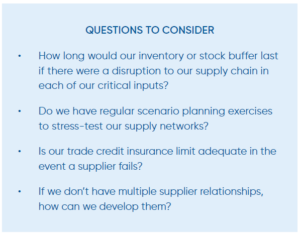
Weather events, transportation bottlenecks, and geopolitical instability have made supply disruption more frequent and costly. Many losses today stem from dependency on others, not physical damage. Suppliers fail or are blocked or waylaid; shortages of critical ingredients, inputs, or parts result from trade, production, and other irregularities; cold storage and transportation breakdowns cause spoilage or other loss of cargo; and you can lose contracts or suffer penalties due to delayed delivery.
Some of these events are insurable with contingent business interruption insurance and transit, stock, and trade credit coverages, so an analysis of your supply-chain dependencies should be conducted. You may need to build out supplier relationships or adjust your insurance coverage.
 Robotics, Artificial Intelligence, and Data
Automation and robotics can improve safety, address labor shortages, optimize resources, and assist in making data-driven decisions. They can serve as the backbone of precision agriculture as well as modern food and beverage processing, packaging, and distribution.
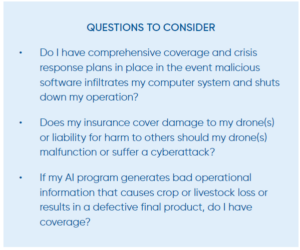
They also, however, introduce nontraditional risks. Equipment, software, and utility failures can disrupt operations at critical points, and cyberattacks are a persistent and ongoing threat to all links in the food and beverage supply chain. Errors in data can affect everything from planting times to care of livestock and crops, labeling, and shipping.
There can be substantial gaps between the risks that automation and artificial intelligence (AI) create and the property and liability protections provided by traditional insurance policies. Many data, AI, and internet-driven equipment exposures can be insured, but policy language may need to be negotiated or endorsements attached to address possible losses, such as equipment breakdown, pollution liability, or first-party cyber-induced business interruption or crop damage, for example.
Cyberattacks increased in the food/ag industry more than 27% from 2024 to 2025, according to the Food and Ag-ISAC 2025 Ransomware Report. Our cyber insurers can provide services such as risk assessments, incident response planning, active monitoring, and/or employee training before a cybersecurity event even occurs. This is extremely valuable, expert input that can substantially improve cybersecurity, because an incident occurring is not a matter of if but when.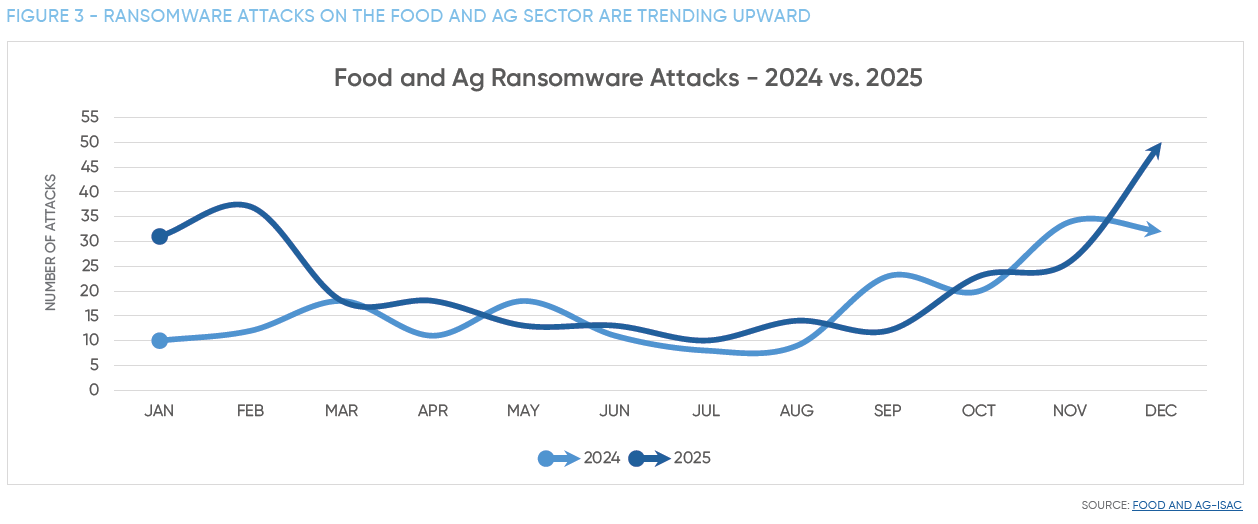
 Volatile Weather
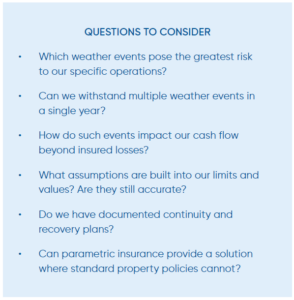
Extreme weather events such as hurricanes, flooding, drought, heat stress, freezes, wildfire smoke, and excessive rainfall are a core operating risk and create compounding losses.
For growers, processors, and integrated operations, impacts can extend far beyond physical damage, interrupting supplies, causing reduced yields, and extending downtime. Impacts also include labor displacement and cash-flow strain driven by deductibles, waiting periods, and uninsured losses.
Your Partner in Protection
Asking the right questions and developing a culture of continuous improvement in risk management are the primary ways of controlling costs—not only in terms of insurance premiums but also in productivity, efficiency, and crisis preparedness.
IOA’s food and agriculture team helps clients identify evolving risk exposures, close coverage gaps, improve resilience, and protect profitability, while supporting growth and operational confidence. Whether you are a grower, processor, distributor, or somewhere else on the food and beverage supply chain, we are your bridge to an insurance and risk management program designed for today’s realities. Contact us to get started with a review of your risk and insurance.
Written by
Staff Writer
|August 10, 2026
Jump to section
01
State of the Market
02
Insurance Trends
03
Major Risks for Food/Ag Businesses
04
Your Partner in Protection