
Business insuranceInsightsRisk Management
Soft Market Deepens as Every Account Size Posts a Decrease
Written by: Bevrlee Lips | September 30, 2026
Jump to section
01
PREMIUM PRICE CHANGES – BY SIZE
02
PREMIUM PRICE CHANGES – BY LINE
03
NOTEWORTHY LINES – Commercial Property
04
NOTEWORTHY LINES – Umbrella
05
NOTEWORTHY LINES – Commercial Auto
06
OUTLOOK
An overview of The Council of Insurance Agents & Brokers’ Commercial Property/Casualty Market Index Q2/2026 and marketing conditions ahead
PREMIUM PRICE CHANGES – BY SIZE
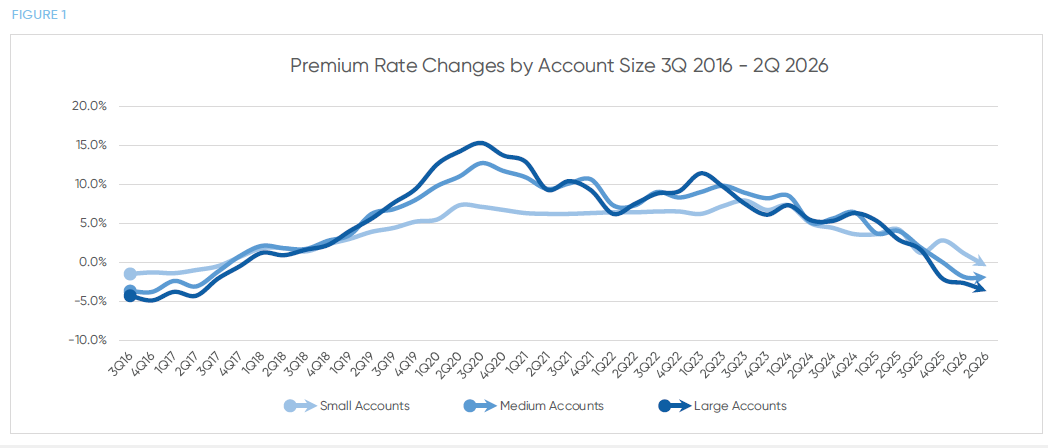
The commercial insurance market extended its soft-market trajectory in Q2 2026, with premium decreases accelerating to an average of -2.0% across all account sizes, from -1.2% in Q1. For the first time in 34 quarters, every account size posted a decrease—a milestone that underscores how broadly the soft market has taken hold.
Large accounts led the decline at -3.7%, following the trend of the past two quarters in which larger accounts have experienced the most competitive pricing dynamics. Medium accounts came in at -1.9%, matching their Q1 result, while small accounts entered negative territory for the first time, posting a 0.5% decrease after the 1.1% increase recorded last quarter.
Respondents described market conditions like those in Q1: downward pressure on premiums across most lines, more carrier appetite for business, and greater willingness from carriers to adjust pricing to retain clients.
PREMIUM PRICE CHANGES – BY LINE
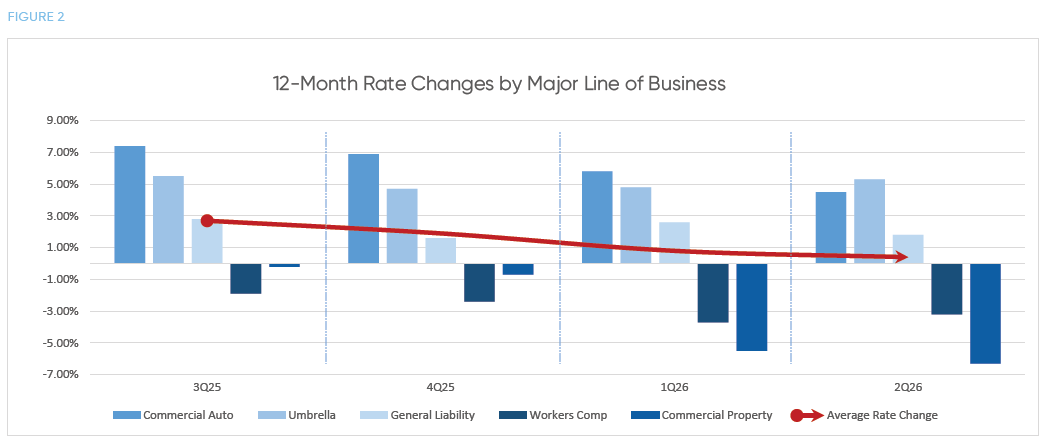
The softening trend was equally evident across lines of business. Ten lines posted premium decreases in Q2—one more than in Q1—encompassing business interruption, commercial property, construction risks, cyber, D&O, employment practices, flood, marine, terrorism, and workers compensation. Of the six lines that recorded increases, two (broker E&O and surety bonds) came in below 1%, and two others (general liability and medical malpractice) averaged just 1.8%.
Across all tracked lines of business, including the major lines, premiums declined by an average of 0.3%. The average increase across the five major lines (commercial auto, commercial property, general liability, umbrella, and workers compensation) narrowed to just 0.4%, down from 0.8% in Q1. Despite the broad softening, commercial auto and umbrella remained the two lines sustaining the most meaningful increases.
NOTEWORTHY LINES – Commercial Property
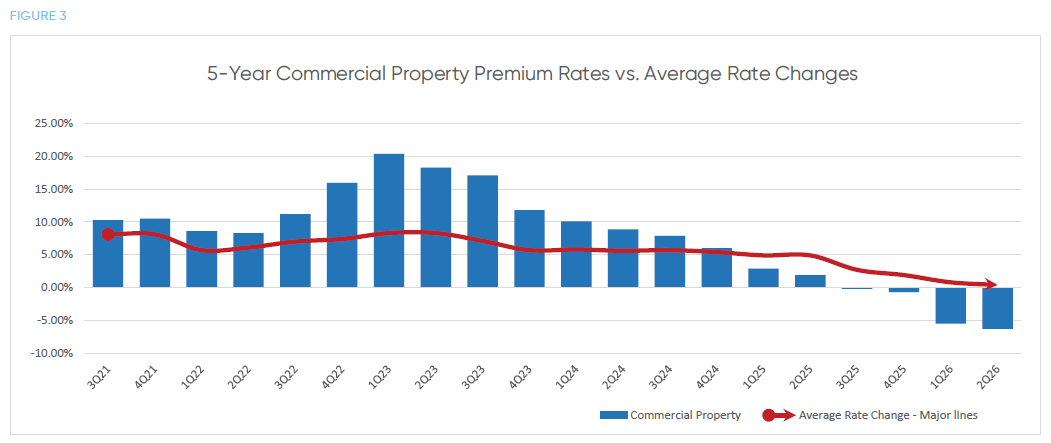
Commercial property posted its fourth consecutive quarter of premium decreases in Q2, with premiums falling 6.3% on average—the largest decrease of any line and an acceleration from Q1’s -5.5%. The Q2 result also represented the steepest single-quarter property premium decline since Q2 2010 (-7.0%) and marks a full year of consecutive decreases for the line.
The drivers are consistent with prior quarters: abundant capacity and carriers’ using property pricing as a tool to offset increases elsewhere in their portfolios. One respondent noted that carriers were “softening workers compensation and property pricing to absorb umbrella increases”—a deliberate cross-line strategy that is benefiting property buyers. With 75% of respondents reporting an increase in property capacity, competitive dynamics continue to intensify.
The benefits have been tangible and broad. Large property accounts saw renewals come in more than 10% lower in some cases. Middle-market accounts experienced significant reductions in rates along with increased sublimits. Deductibles also improved, particularly for wind and hail, as carriers competed for business on multiple fronts beyond price alone.
As in prior quarters, outcomes vary by account. Individual risk characteristics—location, construction, occupancy, and loss history—continue to influence how aggressively carriers will compete on a given renewal. The right advisor with strong carrier access can make a meaningful difference in translating favorable market conditions into the best possible result for each client.
NOTEWORTHY LINES – Umbrella
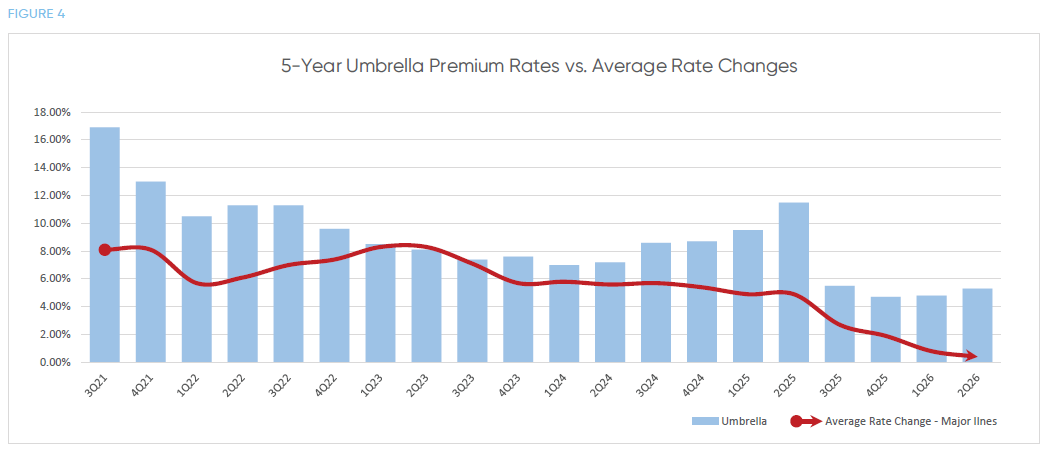
Umbrella premium increases edged upward after having reached a 29-quarter low of 4.7% in Q4 2025. In a streak now approaching nine years, Q2 2026 saw the 35th consecutive quarter of increases for the line as it came in with a 5.3% increase. Industry sources point to the frequency and severity of nuclear verdicts as the defining factor in the line’s persistent firmness.
In its August 2026 report Corporate Verdicts Go Thermonuclear, Marathon Strategies noted that 2025 saw the largest number of nuclear verdicts in its reporting since 2009, a 40.7% increase over 2024. “Since the Great Recession, these verdicts have been rising in number, size, and geographic scope. In 2025, ‘Thermonuclear’ verdicts—a term we coined to describe those greater than $100 million—topped 40 cases for the second year in a row. Four of these verdicts exceeded $1 billion,” the report notes.
Carriers responded to these conditions by becoming more conservative with limits, a finding echoed across multiple industry sources. Approximately 40% of survey respondents reported a contraction in umbrella underwriting capacity, an indicator of more disciplined carrier underwriting that often signals a firmer market environment within a line.
Beyond litigation, underwriters are also contending with PFAS (per- and polyfluoroalkyl substances, or “forever chemicals”) exposures and the emerging liability implications of artificial intelligence. These evolving risks add complexity to an already-challenged line and underscore the importance of reviewing excess liability programs carefully, even in a broadly soft market.
NOTEWORTHY LINES – Commercial Auto
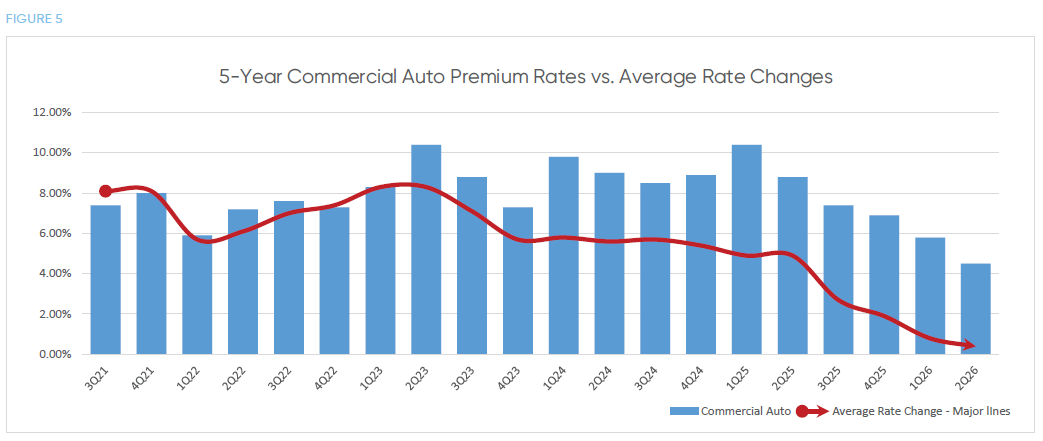
Commercial auto premiums increased 4.5% in Q2, the second-highest increase of any line and the 60th consecutive quarter of increases for the line—a streak now spanning 15 years. While the rate of increase has moderated from the double-digit territory seen in 2025, the underlying challenges remain.
The same factors that have driven commercial auto premiums higher for a decade and a half continue to dominate: distracted driving, congested roads, and the compounding effect of social inflation on claim severity. When claims involving serious injuries or fatalities enter litigation, the resulting verdicts have grown significantly, and those large verdicts ripple into umbrella coverage.
The spillover from commercial auto into umbrella is particularly notable this quarter. As nuclear verdicts breach primary auto limits with increasing frequency, excess layers absorb a disproportionate share of loss, keeping umbrella pricing elevated even as the broader market softens. These two lines together represent the clearest reminder that soft market conditions are not universal.
Proactive risk management remains the most practical lever available to organizations with commercial auto exposure. Telematics programs, fleet safety protocols, documented driver behavior monitoring, and accident response procedures all contribute to a more favorable risk profile.
OUTLOOK
Q2 2026 reinforces what Q1 established: the soft market is real, broad, and deepening. With every account size now posting decreases and 10 lines recording premium reductions, buyers across most segments of the commercial market are in a favorable position.
For organizations navigating this environment, a few considerations remain important:
The opportunity is real but uneven. Property, cyber, workers compensation, and D&O continue to offer meaningful savings and improved terms. Commercial auto and umbrella remain outliers driven by litigation dynamics that pricing alone cannot resolve. Understanding which lines offer genuine opportunity and which require continued risk management focus is essential to a sound renewal strategy.
Better terms matter as much as lower premiums. Soft markets create the opportunity to improve coverage structure, not just reduce cost. Lower deductibles, higher sublimits, broader coverage conditions, and reduced retentions are all achievable in the current environment. Buyers who focus only on premium savings may leave meaningful value on the table.
The litigation environment is a wildcard. The frequency and severity of nuclear verdicts, combined with ongoing third-party litigation funding activity, remain significant forces shaping carrier strategy in auto and umbrella. Progress on litigation reform at the state and federal level could eventually moderate these pressures, but no near-term resolution is in sight.
Market cycles turn. The last soft market, which ended in Q4 2017, was followed by several years of meaningful rate increases. Organizations that use the current environment to strengthen their programs, build carrier relationships, and invest in risk management will be better positioned for whatever comes next.
IOA remains committed to helping clients capitalize on today’s market with strategic guidance and the deep carrier partnerships that translate favorable conditions into real results at renewal.
Written by
Bevrlee Lips
|September 30, 2026
Jump to section
01
PREMIUM PRICE CHANGES – BY SIZE
02
PREMIUM PRICE CHANGES – BY LINE
03
NOTEWORTHY LINES – Commercial Property
04
NOTEWORTHY LINES – Umbrella
05
NOTEWORTHY LINES – Commercial Auto
06
OUTLOOK