
InsightsPersonal insurance
Below Normal Activity Predicted for the 2026 Atlantic Hurricane Season
Written by: Staff Writer | June 8, 2026
Jump to section
01
A Welcome Forecast with an Important Caveat
02
Now Is the Time to Review Your Coverage
03
Check the Details of Your Insurance Policy
04
Windstorm Coverage
05
Flood Insurance
06
Comprehensive & Collision Auto Coverage
07
Know Your Hurricane Deductible & Other Costs
08
Update Your Policy to Reflect Your Needs
It’s hurricane season and preparations once again are underway. While the Pacific hurricane season begins on May 15 and the Atlantic season is close behind opening on June 1, both end on November 30. No matter what is predicted each year, however, readiness remains the key in staying safe for every season.
Let’s take a look at what expert forecasters say is in store this year and the types of insurance you may need to ensure your protection.
A Welcome Forecast with an Important Caveat
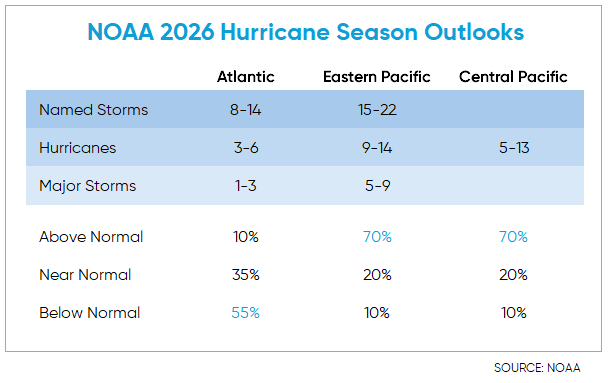 The National Oceanic and Atmospheric Administration (NOAA) released its predictions for the 2026 season on May 21, offering some relatively welcome news for eastern coastal communities, which are typically the hardest hit: a below-normal Atlantic hurricane season is forecast this year. NOAA gives a 55% chance of a below-normal season, a 35% chance of a near-normal season, and only a 10% chance of an above-normal season.
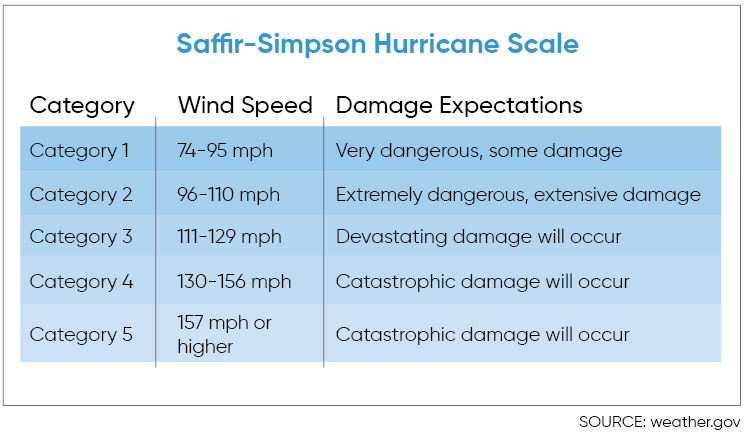
In terms of specific storm activity, NOAA forecasters are predicting 8 to 14 named storms (winds of 39 mph or higher). Of those, 3 to 6 are forecast to become hurricanes (winds of 74 mph or higher), including 1 to 3 major hurricanes (Category 3, 4, or 5, with winds of 111 mph or higher). For reference, an average season produces 14 named storms, seven hurricanes, and three major hurricanes. NOAA has 70% confidence in these ranges.
The primary driver behind the calmer outlook is the expected development and intensification of El Niño conditions during the hurricane season. El Niño typically suppresses Atlantic hurricane activity by increasing upper-level wind shear, which disrupts storm formation and intensification. However, there are competing factors at play: ocean temperatures in the Atlantic are expected to run slightly warmer than normal, and trade winds are likely to be weaker than average, both of which tend to support more active hurricane development.
As NOAA’s National Weather Service Director Ken Graham put it, “Although El Niño’s impact in the Atlantic Basin can often suppress hurricane development, there is still uncertainty in how each season will unfold. That is why it’s essential to review your hurricane preparedness plan now. It only takes one storm to make for a very bad season.”
We wholeheartedly agree and would add that a below-normal forecast is no reason to let your guard down.
Now Is the Time to Review Your Coverage
With an overall increase in storms causing at least $1 billion in damages in recent years, it’s more important than ever to make sure your assets are protected in the event of a natural disaster, regardless of how active a season is predicted to be.
Many property owners delay purchasing or updating their insurance coverage until a storm is approaching. If this is you, beware. Insurance companies often impose a moratorium on issuing new policies or making changes to existing policies once a named storm is projected to impact a region. That makes now the best time to take action to protect your property and belongings from the cost of potential damage.
Check the Details of Your Insurance Policy
In addition to what is provided in a standard homeowners policy, it is important to consider other coverages that essentially equate to hurricane insurance. A combination of these policies can close gaps in the protection of your property.
Windstorm Coverage
If you live in an area that experiences high-wind and hail events, you may want to consider adding windstorm coverage. Most policies will have a percentage deductible, and coverage applies whenever damage is caused by wind, hail, or other named perils. It raises coverage limits and typically goes into effect after 15 days, but longer time frames may be required. Perils such as flooding and fire are not covered under this type of policy.
Flood Insurance
It’s a common misconception that flood damage coverage is included in homeowners insurance policies, but that is not the case. Damage resulting from stormwater, an overflowing body of water, or other similar events typically are not covered.
The Federal Emergency Management Agency (FEMA) states that, “Flooding is the most common and costly natural disaster in the United States. [From 2019-2024], all 50 states have experienced floods or flash floods. Even just one inch of water can cause $25,000 of damage to your home.”
If you live in a high-risk area for flooding, you may be required to have flood insurance. If not, it still may be a prudent consideration for your home or property. Keep in mind that flood insurance policies typically go into effect after 30 days, so purchasing this option well in advance of a natural disaster or storm event is crucial.
Comprehensive & Collision Auto Coverage
If you’ve purchased an auto collision policy, you are protected from damage to your vehicle in the event it collides with another vehicle, person, or object, whether you or someone else is at fault. That includes flash flooding, falling trees, or other damages caused by a storm. For damage not caused by a collision, comprehensive coverage provides protection for damage from hurricanes, fire, flood, and other acts of nature. Coverage typically goes into effect upon receipt of payment.
Know Your Hurricane Deductible & Other Costs
In most high-risk states, homeowners insurance policies contain a percentage deductible for hurricane coverage, which typically falls between 2% and 5% of the home’s insured value. For example, if your home is worth $300,000 and you have a 3% hurricane deductible, you’re responsible for paying the first $9,000 in damages before coverage goes into effect. If you’re unaware of what your hurricane deductible is, make sure to check your policy or contact your insurance advisor to be properly prepared.
Review your policy limits and consider whether you might need additional insurance. Ask questions such as: Does my policy cover the cost to rebuild my home? Does it include additional living expenses (ALE), and if so, for what period of time?
If a disaster is declared for a specific region as a result of catastrophic damage, funding could be issued through FEMA for claims provided they fit within its requirements. However, funds are not guaranteed and likely would not be available immediately when you need them most.
Update Your Policy to Reflect Your Needs
To safeguard your belongings, review your current policies and connect with your insurance advisor to ensure you’re properly protected and prepared for whatever may come your way this season. A below-normal forecast is reassuring, but it is no substitute for having the right coverage in place before a storm ever forms.
If you would like to find out more, request a quote online or speak to an IOA advisor today by calling (833) 546-2872.
For weather enthusiasts, find all 2026 storm names and their pronunciations here.
Written by
Staff Writer
|June 8, 2026
Jump to section
01
A Welcome Forecast with an Important Caveat
02
Now Is the Time to Review Your Coverage
03
Check the Details of Your Insurance Policy
04
Windstorm Coverage
05
Flood Insurance
06
Comprehensive & Collision Auto Coverage
07
Know Your Hurricane Deductible & Other Costs
08
Update Your Policy to Reflect Your Needs