
Business insuranceInsightsRisk Management
Construction Insurance Market Stabilizes, Though Certain Segments Remain Challenging
Written by: Staff Writer | November 2, 2026
Jump to section
01
State of the Market
02
Insurance Trends
03
Regional Trends
04
On the Horizon
05
Complexity Needs Expertise
Overall, U.S. commercial construction insurance is in a period of stability or even favorable rates, with some regional challenges on certain lines. North American construction activity contracted 1.4% in 2025 and is generally flat this year, though office construction (data center driven) is up 6% and power infrastructure is predicted to grow 14% by 2028, according to FMI’s 2026 North American Engineering and Construction Outlook.
State of the Market
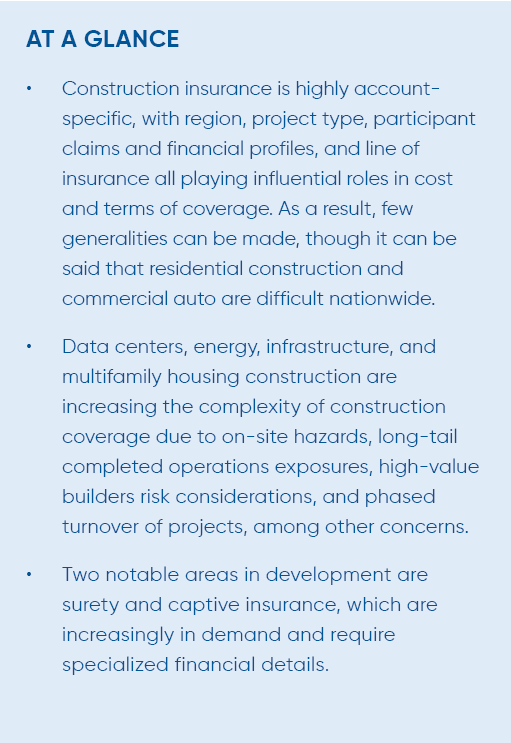 New building trends include data centers, energy, affordable housing/adaptive reuse, and heavy civil work. These sectors tend to require specialized labor in the subcontractor fields, and skilled labor is being swallowed by other industries across all job types, meaning construction firms are paying more and struggling harder to find qualified workers.
Laws and construction activity vary by region, and insurance costs are heavily dependent on maturity of the business, loss history, financial strength of the partners involved, and the construction sector—for example, residential and tract housing have challenges nationwide on general liability and excess pricing and availability, especially in admitted markets.
There also are new unknowns in the commercial construction sector. Despite broad availability of coverage, there are complexities in long-tail completed operations coverage for newer risks, such as data centers. Data centers and other infrastructure projects including communications, energy, and water present unique risks during construction and after completion that call for new and increasingly specialized approaches to insurance, risk transfer, loss control, and claims management. Addressing these exposures requires construction firms and their insurance partners to look beyond conventional approaches and develop strategies tailored to the specific risks of each project.
Insurance Trends
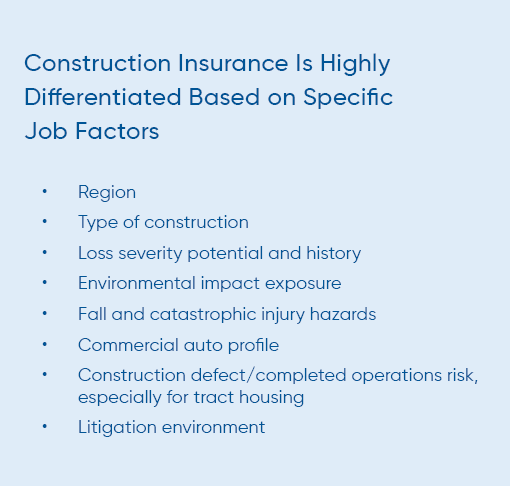 There are few generalities applicable nationwide for construction since each account’s rates depend on company and job details. Nonetheless, generalized averages can give a sense of the health and challenges of the industry. The Council of Insurance Agents & Brokers’ Q2 Market Index 2026 says that construction accounts across all U.S. regions and lines of coverage saw average premium changes from Q1 ranging from 1%–9% decreases (29% of accounts) to 1%–9% increases (19.4% of accounts), with about 39% reporting no change in overall premiums.
Residential construction insurance by and large faces some pressure across the country, especially in condos, townhomes, and tract housing developments. Carriers continue to raise rates and restrict coverage offerings for these types of projects and contractors working in them, especially in states with heavy construction defect litigation.
Commercial auto insurance continues to be problematic throughout the U.S., with the average rate rising 4.5% in the second quarter, according to the CIAB’s 2026 market index. That is an improvement from previous recent quarters, but it is still one of the most difficult and expensive lines to place.
Excess liability insurance also is a pain point. Increases largely reflect carrier aversion to the line because of massive volatility in liability lawsuit verdicts. Insurers like predictability, which is not a characteristic of jury awards. Moreover, even where severity is less of a problem, the frequency of complaints is driving costs associated with smaller settlements and attorney involvement.
Builders risk rates have softened in general, and availability is reasonably accessible. However, there are issues having to do with wildfire, commercial-to-residential conversions, and expensive, specialized systems involved in cooling, power supply, and security.
Surety is rising as an area of focus for contractors across all job types. There is an increasing demand for bonds on projects of all sizes, even for private jobs that are financed.
Project -specific approaches such as OCIP and CCIP wrap-up programs continue to be widely utilized on larger construction projects, with GL-only programs continuing to grow in popularity, driven in part by the ability to implement them on smaller projects and their simplified administration process, access to specialized third-party administrators, and easy market access to a broader range of agents and brokers. The increased use in these GL-only programs also has been supported by a difficult insurance environment in certain regions and classes of business, where project-specific liability solutions can provide a more efficient coverage and cost strategy.
OCIP/CCIP market conditions have generally stabilized for most projects, with for-sale residential remaining an exception. Increased capacity and competition have contributed to more favorable rates and terms than in recent years. However, GL-only wrap-up programs and policy forms still vary from carrier to carrier, making careful review of policy language critical to ensure that coverage aligns with the intended program structure and risk management objectives. An experienced construction broker can help owners and developers navigate the nuanced coverage challenges presented by non-standardized, carrier-specific forms and approaches as well as coordinate the wrap-up with other project coverages such as builders risk.
Regional Trends
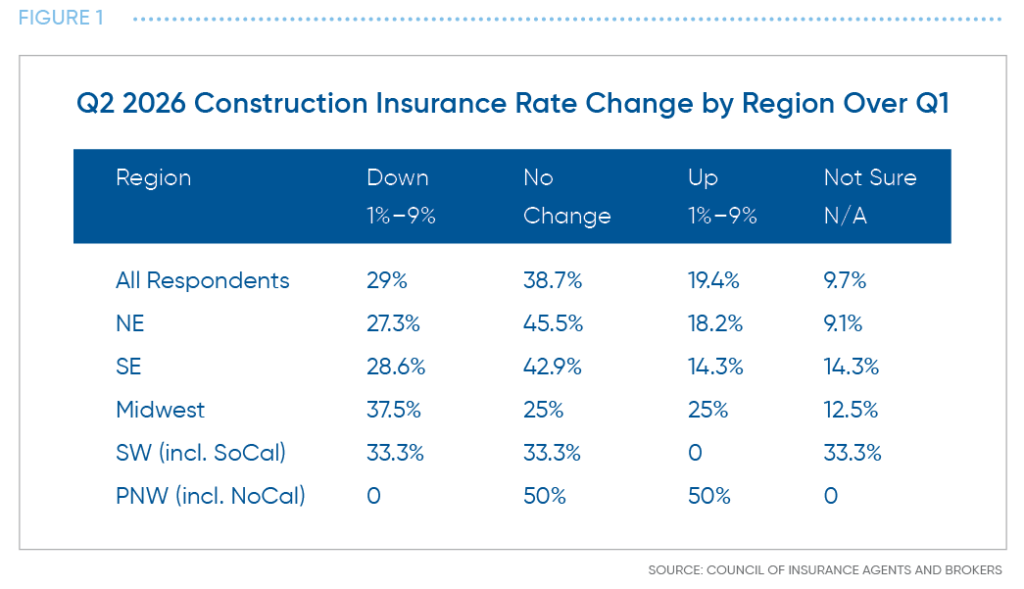 While premiums across the broad construction sector are still rising well above the rate of inflation, there are some bright spots, especially in commercial construction, with new carriers entering the market and bringing competition. Residential, on the other hand, is a struggle in most regions, especially in general liability and excess. And where manageable rates can be found, whether in commercial or residential, carriers are scrutinizing loss controls, contractual liabilities, claims histories, and property and site reports.
Northeast
The Northeast admitted market is very competitive for commercial construction, though some limitations remain for residential. Most notable in the New York market is the persistence of difficulties emanating from the state’s body of labor law, particularly the Scaffold Law, which assigns absolute liability in gravity-related injuries. New York labor law applies to owners and contractors based in New York as well as those coming into the state for jobs, which means contractors and subs based outside New York may need to adjust their coverage if they accept work in the Empire State.
Minimum premiums for NYC exterior height work via direct trade payroll can be very high. The options for this exposure for more than a 1/2/2 ($1 million per occurrence; $2 million GL aggregate; $2 million product-complete operations) are very limited. Carriers supplying lower MPs generally won’t write exterior exposures over two stories in NYC. So clients are left with the markets that write the toughest of the tough, and they have very high MPs, potentially into the six figures.
Securing excess limits is often more difficult. Many excess insurers will not attach at $1 million primary and need a minimum of $2 million to $5 million before they attach. The rates can exceed that of the primary $1 million. Obviously for higher limits, carriers will need to be stacked.
Office-to-apartment conversions, along with warehouse conversions to residential, are big in the Northeast. Nationally, the number of office-to-apartment projects in the pipeline rose 28% in 2026 for the second year in a row. New York leads the pack with more than 16,000 projects planned, followed by D.C. at just under 8,500 and Chicago in third place with 4,360 as of March, according to RentCafe.
Adaptive reuse projects have some challenging insurance aspects; for example, there is increased exposure on professional liability for engineering errors, contractors E&O, liability for faulty materials, site pollution, delay in completion coverage, and builders risk. Additionally, insurers are requiring PCARs (property conditions assessment reports) to be done by an approved quality control company to assess existing building conditions.
Large projects are consistently deploying new technologies to reduce risk of loss. Those include water-loss controls and body-worn cameras that map buildings and allow contractors to see if any specs are off.
In Northeast residential construction, general liability and excess/umbrella are experiencing limited availability of admitted carriers as well as pricing pressures. Some states are attempting to put the brakes on the runaway effects of litigation financing, which funds a plethora of nuisance lawsuits as well as more aggressive plaintiff actions that are all geared to force insurers to capitulate into a settlement before court costs and potentially sky-high verdicts land.
Pennsylvania this spring issued a formal notice of rulemaking to force transparency at the discovery level in lawsuits to try to make it clear that investors are heavily influencing these actions—even more so than victims. GL rates are already starting to improve, and new carriers are expected to enter Pennsylvania when the final rule is published. We will keep clients updated on the progress of that effort, which was under consideration by the state Supreme Court’s Civil Procedural Rules Committee at the time of this publication.
Southeast
General liability and excess liability coverages for residential construction are still a challenge in the Southeast, as elsewhere. Admitted markets are very limited for single-family and tract housing. The few markets willing to entertain tract homebuilders’ submissions are insisting on demonstrable loss controls, such as good sub agreements, rigorous cert management, and quality control programs and written protocols for homeowner disputes. Even with these measures in place, very few admitted markets will offer excess limits over $5 million, with some capping their offering at $2 million.
In the Florida market, there hasn’t been significant relief yet on rates from the shortening of the statute of repose (from 10 years to 7) on construction defect lawsuit filings. We are keeping a vigilant eye on that trend to see if the law generates any relief.
Commercial construction insurance in the Southeast is plodding along with little drama. Coverage is available across lines with flat rates or, in some cases, decreases in premiums. The marketplace can be downright competitive for some classes of business, and the modest recent losses due to weather have helped. However, excess capacity in South Carolina remains an issue, where very few, if any, admitted markets are posting excess/umbrella limits north of $5 million. This is driven largely by nuclear verdicts on auto claims and the legal climate in the Palmetto State.
Commercial auto—especially in South Florida—is a major problem, with hikes of 15% or more in premiums. Fleets with more than 25 units have been hit particularly hard; although, commercial auto tied to non-residential contractors is seeing some relief in South Florida, especially on fleets of fewer than 25 vehicles. South Carolina and Georgia have endured the same kind of rate increases along with very limited market options due to admitted markets’ extremely stringent underwriting guidelines. For example, some carriers are mandating that fleets of over 10 units must have dash cameras and telematics.
Accounts with more than $250,000 in GL, commercial auto, or workers comp premium are looking more seriously at captives, which are very available and widely shopped to clients. Small accounts are gravitating toward group captives, while capable, large accounts are more interested in single-parent captives or fronting arrangements. For all captives, but especially commercial auto, a clean safety record is a major benefit.
 Southwest (not California)
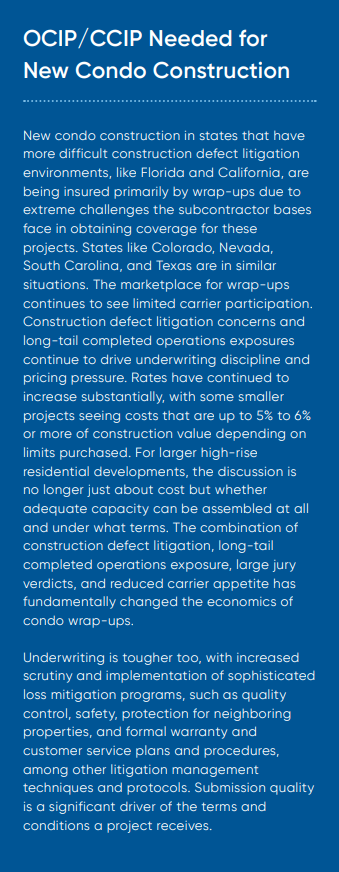
Residential tract construction is struggling because of a negligible number of markets, and when coverage is available, it comes with unit count limitations and product liability exclusions. Prices are rising as a result of the lack of competition and availability of markets.
Commercial construction is going strong. Markets are available and competitive. Owner- or contractor-controlled insurance programs are frequently recommended for developers and general contractors to minimize the chance of gaps in coverage and to make claims more manageable.
The Southwest has seen a recent increase in large-project, private-developer requests for surety bonds, so this is a developing area we are watching. So far, the surety markets have been available and receptive.
For commercial auto placements, it is common to need to piece together coverage. Primary and excess limits are restricted, and excess attachment points are demanding. There is some relief in pricing and availability if the client will use the same carrier for workers comp and auto, but monoline auto is dicey. All it takes is a couple careless employees for monoline to become completely unavailable to a business.
California and the Western U.S.
The outlier story in this region is workers compensation. Across the nation, rates are generally down, but in California, workers comp carriers are struggling, with an advisory pure premium rate of 6.6% for Sept. 1, 2026. Last year’s combined ratio was high at 127%, signaling significant adverse claims results and operating costs. Still, new players continue to enter the California workers comp market with surprisingly low rates. Commercial auto remains a serious problem, as there are only a handful of monoline auto markets left in the state. Brokers are having to get creative on placements, including looking for package carriers that will quote auto alongside workers compensation.
Solid insurer participation is seen in the general liability sector, with new entrants popping up when rates get high, thereby counterbalancing incumbent insurers’ premium increases. But general liability policies are sometimes being limited by wildfire exclusions, meaning if a client’s operations start a wildfire, no cover is available under the policy.
Builders risk is also seeing rate and placement challenges because of wildfire risk. Layered programs are usually needed to cover exposure, especially for high-value frame projects.
Contractors equipment coverage in California is stable, largely because yellow metal is not being stolen that much—or at least can be found if it is.
Excess liability/umbrella are typically being layered to achieve needed limits because some standard markets have capped their limit at $5 million. Clients often must turn to wholesalers to obtain limits above that level.
On the Horizon
There are four particular areas generating great interest—and challenges—in the U.S. construction insurance sector: data centers, power infrastructure, heavy civil projects, and the use of AI. Each brings new demands for coverage, and carriers are feeling their way through some of the exposures, tweaking policy language and appetite as they go.
Data centers
Data center projects can exceed billions of dollars in value and carry elevated fire risk from welding and electrical installs and loads. They also have exposure to water damage from cooling pipes as well as the standard natural catastrophe concerns. Alignment of coverage across multiple insurers and project participants is crucial to avoid gaps.
Builders risk is a segment that is particularly challenged by the complexity and cost of data center projects. This is due to the numerous expensive and intricate systems for cooling, power supply, and security. Add to that project delay/loss of income coverage and the phased handover of projects, where part of the building is operational and part of the building is under construction, and you get a new set of parameters for insuring these massive risks. The level of diligence required to prevent gaps is increasing.
Workers comp concerns in this sector are expected to remain elevated due to high-voltage and hazmat risks.
The employment of highly specialized and qualified subs also is expected to grow and be part of the underwriting evaluation.
Contractors need to demonstrate quality loss controls and have tight risk transfer language. A best practice going forward is to use carrier-provided risk engineers to assist with project evaluation and ongoing loss controls.
Expect data center projects to demand much more in terms of risk evaluation and advice from brokers. The role of parametric insurance in providing rapid disaster-recovery resources also is predicted to grow.
Power infrastructure
Q1 2026 starts were up 21.2% from 2025’s first quarter, according to the ConstructConnect Insight Forecast, and growth is expected to remain strong, especially for battery storage, rooftop solar, and small gas turbine projects.
These projects carry with them many of the same exposures, loss-control, and cost concerns as data centers. A focus on safety, environmental, general liability, and product liability are expected to rise as labor markets and supply chains are pinched due to accelerating demand versus supply realities.
Heavy civil construction
Budgets for ports, waterways, and flood control infrastructure are up, and that includes dredging for channel deepening, coastal restoration, and port maintenance. Sewage and waste disposal, water supply, and conservation and development projects all have strong growth prospects as well.
Demand for surety bonds is expected to increase substantially as a result as is the use of drones, which will likely complicate more construction accounts. The drone effect will have liability repercussions, since most general liability policies carry a drone exclusion. Coverage may need to be placed under an aviation policy for unmanned aircraft, though sometimes it can be added as an endorsement to GL. There will be considerable underwriting involved in coverage, including size and number of drones, qualification of operators, how the drones are used, and their storage.
Technological enhancements to contractor equipment are expected to increase, including adaptations such as precision GPS integrated with universal total station tech on bulldozers, excavators, and graders. These improve mass excavation site prep but also drive up equipment value and, therefore, the price of coverage.
Artificial intelligence
AI is skyrocketing in both development and application in the construction industry, and the insurance industry is undergoing the typical new-exposure adaptation pains. While AI exclusions have been rare so far, reports are emerging that numerous carriers are limiting or excluding AI-related losses from certain coverage lines. We are watching these developments to identify potential gaps that may ensue and will alert clients to any upcoming changes to policy language.
Cyber-affiliated exposures require careful correlation of cyber and other coverages to ensure AI gaps are accounted for. And it appears that property damage and various liability policies may follow suit as carriers learn how AI will play a role in areas beyond cybersecurity.
Complexity Needs Expertise
With geopolitical instability affecting prices and availability of fuel and materials, cyberattacks growing more pervasive and instantaneously disruptive, and competition for qualified labor shrinking the available workforce for specialty construction jobs, developers and contractors have an expanding risk landscape to manage.
IOA construction brokers are deeply familiar with coverages and regional anomalies. We also leverage the specialized knowledge of IOA-wide insurance lines experts—for example, in cyber, management liability, and workers comp. Whether it’s monoline insurance, layered protection, or OCIPs/CCIPs, our team is ready to help you tackle the complexities of construction risk.
Written by
Staff Writer
|November 2, 2026
Jump to section
01
State of the Market
02
Insurance Trends
03
Regional Trends
04
On the Horizon
05
Complexity Needs Expertise